Milly
My left thumb had turned blue from the notice-board flyer I was pretending to straighten.
The corridor outside my honors statistics seminar in Loomis Hall, Westbrook’s concrete science building, had emptied around me. I stayed beside the board with my backpack over one shoulder and watched Bennett Shaw make four girls from his research lab laugh.
He stood at the center of their loose circle, tall and slim in a pale-blue oxford and fitted chinos. His dark hair was neatly trimmed, as usual. Even the small bump in the bridge of his nose looked intentional, a flaw selected to keep the rest of his face from appearing too perfect.
One of the girls touched his sleeve while she spoke. Bennett listened with his head slightly inclined, gray eyes narrowed in calm attention. His long hands rested at his sides. He never fidgeted. I had spent two semesters interpreting that stillness as proof that his thoughts ran too deep for nervous movement.
I wanted him.
There was no dignified academic phrasing available for it. I had a crush on Bennett Shaw, and it had survived two semesters without a single encouraging event.
I had imagined him noticing me after seminar. He would say, “Milly,” in that measured voice of his, pitched low enough to make me lean closer. He might ask about my thesis plans or offer to walk me across the quad. In more reckless versions, his careful hand settled against my back as I stood beside him among his friends.
That last part mattered almost as much as the hand.
People would look at us and know I belonged there. Bennett would choose me openly, and his attention would turn me from the pale girl near the notice board into someone worth remembering.
Professors knew me. Professor Landry had stopped me after class to praise my regression model. Ten minutes later, a girl from the same seminar had asked whether I was waiting for someone whose class had just ended.
Bennett smiled at something one of his lab friends said, then glanced toward the stairs.
I lowered my eyes to the flyer.
A summer fellowship in Minnesota. Applications due February fifteenth. I had read it seven times since Monday.
His woody cologne reached me before he did. My heartbeat sped up as he passed close enough for the cuff of his shirt to brush my sleeve if either of us shifted half an inch.
He kept walking.
His eyes moved over the board, then toward the exit. They never touched me.
I stayed there until the stairwell door shut behind him. In the glass covering the notices, escaped strands of hair curled around my face, and the pencil through my bun sat crooked. I pulled my sleeve over the ink smudge on my left hand and checked my watch.
My library shift started in twenty minutes.
Last night, at eleven forty-seven, Josie Tran sat cross-legged on her bed in Britt Hall room 214, our second-floor dorm room, wearing emerald satin pajamas fit for accepting an award.
The dark roots beneath her bleached crop made the color look brighter. Freckles crossed her heart-shaped face, and her small pointed nose wrinkled as she studied the caption on her phone.
“Read this,” she said. “I think it needs more menace.”
I leaned over her shoulder. “It needs a comma.”
“Mills.”
“You asked.”
“I asked about menace.”
“You put an introductory conditional clause in front of forty thousand people without proper punctuation. That is menacing.”
She handed me the phone.
The Westbrook Whispers account was open, its black-and-gold logo sitting above a grainy photo of a silver SUV taking up two faculty parking spaces.
The caption read: If you’re going to steal a professor’s spot at least hide the custom plate.
I added the comma after spot.
Josie owned and ran Westbrook Whispers. I was the only person alive who knew.
The account had started freshman year with anonymous reports about a residence-hall creep who photographed sleeping girls at parties. Now it had just over forty thousand followers and enough influence to ruin a cheating boyfriend’s weekend before he finished breakfast.
Josie and I discussed those followers like a difficult houseplant we shared. Did they need attention? Had we fed them too much?
She approved my comma and posted.
“Thank you for your service.”
“Someone has to maintain standards.”
Her laptop chimed with another submission. Josie opened it and read aloud, “‘Saw Coach Dermott buying six boxes of doughnuts at Keating’s at seven this morning. Explain that, athletics.’”
“He has staff meetings.”
“He has secrets.”
“He has assistant coaches.”
“Those are his secrets.”
I laughed, which encouraged her to reach for another submission.
This was our midnight ritual: Josie read the worst messages, and I stopped her from committing libel or comma splices. Campus slept ten feet beyond our door without knowing two girls in old dorm beds were deciding which parts of its life became public by morning.
Josie tossed her phone onto the blanket. “Breakfast Sunday?”
“Ten o’clock.”
“You’re paying. I covered last week.”
“You stole half my pancakes.”
“That was a quality-control inspection.”
“Your report took six bites.”
She smiled, charming enough to make theft seem generous. “Somebody needs to do something worth posting soon. Campus is boring lately.”
Her phone chimed again.
She reached for it. I opened my statistics textbook and went back to my problem sets. Her phone chimed twice more before I finished the first page.
At eight fifty-six that evening, the fourth floor of Hargrove Library had entered its nightly hush.
Students bent over laptops beneath the fluorescent lights. The worn carpet swallowed footsteps, and pages turning at the study carrels made more noise than conversation. From my service desk near the elevators, I could see three long aisles of humanities stacks and the light above the regular door with a card lock behind them.
The closed stacks began on the other side. Beyond the reserve shelving was the annex, a windowless overflow room with a long worktable, mismatched chairs, and a whiteboard that never quite erased cleanly.
My staff keys hung from a lanyard at my hip.
By nine, I had straightened the return cart, answered two citation questions, and helped a freshman locate a novel she insisted did not exist because the call number contained letters. The fourth floor made sense. Every book had a place, and every question had a better answer than panic.
I carried a reserve box through the card-locked door at eight fifty-eight. It swung shut behind me as I continued toward the annex.
Then a man shouted at the shelves.
“GENERAL CHEMISTRY, TENTH EDITION?”
His voice rolled through the closed stacks and struck metal hard enough to sound offended by the lack of response.
I stopped.
“YOU BACK HERE?”
People did not shout on the fourth floor. They certainly did not shout textbook titles in a restricted area. And from the sound of it, he wasn’t looking for a book at all—he was calling out for a general named Chemistry, which, in fairness, would have made more sense.
I followed the noise around the next shelf.
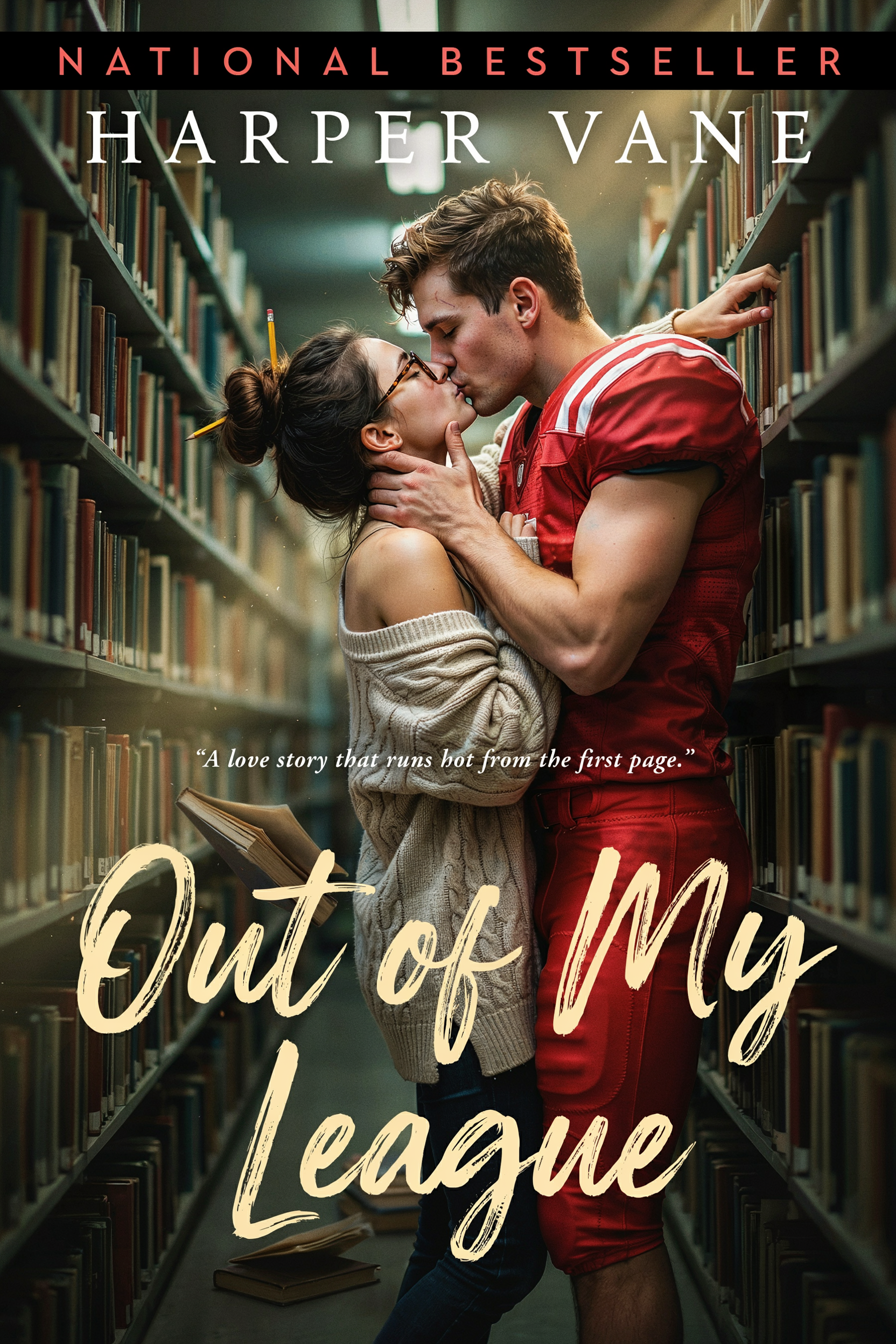
A very large man stood with his back to me, inspecting the top row as if the book might be hiding out of spite. His black Westbrook Football shirt stretched tight across broad shoulders. Dark-gold hair was clipped short at the sides and mussed on top, and one taped hand gripped a pencil that looked absurdly small between his fingers.
“Can I help you?”
He turned.
Recognition arrived with the grin.
Cole Maddox. Starting quarterback. Team captain. His face appeared on posters across campus, usually above a slogan involving victory or legacy. In person, he was less polished and considerably bigger—six foot three, thick through the chest and thighs, with hazel eyes under straight brows. A thin white scar cut through one eyebrow. His grin pulled slightly crooked to the left.
That imperfection was irritatingly effective. So was the shirt tightening across his shoulders when he folded his arms. Heat touched the back of my neck, and I blamed the closed stacks.
“Depends,” he said. His voice was lower now, though it still carried. “You know where the chem reserve is?”
“On the public side.”
“Right. Of course it is.”
His gaze moved to my staff badge, then returned to my face. Amusement lit his eyes.
“How did you get in here?”
“The door opened.”
“It does that for authorized staff.”
“Maybe it liked me.”
I stared at him.
The poster grin widened, apparently accustomed to producing a different response.
“You need to leave.”
“Didn’t know the library came with security.”
“It doesn’t. It comes with staff who expect university seniors to understand a six-word sign.” I pointed past him. “If that’s too ambitious, the public aisles have arrows.”
Silence held for two seconds.
Most people turned defensive when corrected. Some went cold. A few tried to explain why the rule should not apply to them.
Cole looked delighted.
He lowered his head and laughed, the sound roughened at the edges as though I had given him exactly what he wanted.
“Wow,” he said. “All right.”
I kept pointing.
He lifted both hands in surrender. The tape around his knuckles caught my attention, followed by the strong lines of his forearms. My fingers tightened around the reserve-box handle before my brain could object.
“I’m going,” he said. “No need to deploy the arrows.”
“Try following them.”
He walked past me, close enough to bring the smell of grass and clean sweat under cheap sport deodorant. Warmth came off him in the narrow aisle. I stepped aside and hated that my body noticed any of it.
At the end of the row, he turned and offered the shelves a solemn salute.
“Thank you for your service.”
Then he disappeared through the card-locked door.
I stood alone with the reserve box digging into my palm.
I had won. He had enjoyed losing.
That seemed unfair.
At nine, I closed the service desk while the students remained at their carrels under the overnight staff’s watch. I had just hooked the keys back inside the desk when my Learning Commons supervisor hurried from the elevators, a navy cardigan pulled over her work dress and a clipboard tucked against her chest.
“Amelia, good. I caught you.”
Only payroll and official forms called me Amelia.
She lowered her voice as she approached. “I have a confidential assignment. The client’s name is withheld until you sign the disclosure agreement.”
“I’m already carrying a full tutoring load.”
“This one is unusual. High-profile student, strict privacy. You were requested because you’re our strongest tutor for the course.”
“Requested by whom?”
“The dean’s office approved the placement. That’s all I can tell you until you sign.”
She passed me the clipboard. A confidentiality agreement covered the first page, followed by a private-session schedule.
“Tomorrow night,” she said. “Nine o’clock, after your shift. They’ve approved the annex.”
From somewhere in the back of my mind, the crooked grin from the closed stacks surfaced again, uninvited, and went right back to irritating me.
I signed at the bottom and turned the page.
Under SUBJECT, the form read: GENERAL CHEMISTRY I.